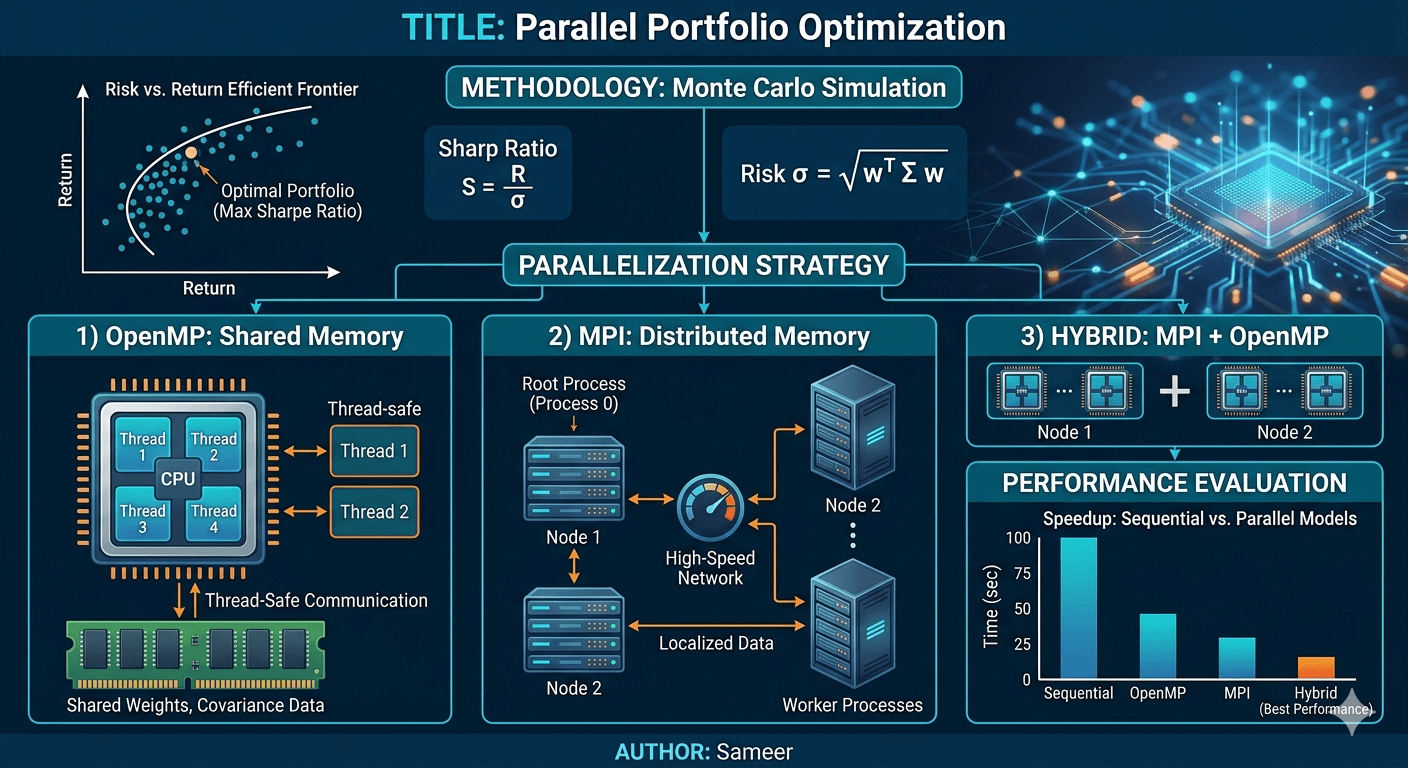
Parallel Portfolio Optimization
By Dheeraj Kumar Bhaskar • March 29, 2026
The Parallel Portfolio Optimization System is a high-performance computing (HPC) project that implements Modern Portfolio Theory (MPT) using Monte Carlo simulation to find optimal asset allocation.
The system leverages OpenMP, MPI, and hybrid parallel computing to significantly accelerate financial computations and improve scalability.
📌 Introduction
This project is based on the Markowitz Portfolio Optimization Model, which aims to construct a portfolio that minimizes risk for a given expected return.
The portfolio variance is computed as:
\sigma^2 = w^T \Sigma w
Where:
- w → asset weights
- Σ (Sigma) → covariance matrix
Due to heavy matrix computations and large simulations, the problem is ideal for parallelization.
🎯 Objectives
-
Build a correct sequential implementation
-
Identify performance bottlenecks
-
Apply parallel computing techniques
-
Compare:
- Sequential
- OpenMP
- MPI
- Hybrid (MPI + OpenMP)
⚙️ Features
-
Monte Carlo Simulation for portfolio generation
-
Sharpe Ratio Optimization
-
Parallel Execution Models:
- OpenMP (multi-threading)
- MPI (multi-process)
- Hybrid (multi-node + multi-core)
-
Efficient Data Pipeline:
- CSV parsing
- Return computation
- Covariance matrix generation
🧠 Methodology
1. Data Preprocessing
-
Input: historical stock prices (
prices.csv) -
Compute:
- Log returns
- Mean returns
- Covariance matrix
2. Monte Carlo Simulation
-
Generate random weights (sum = 1)
-
Compute:
- Expected return
- Risk (standard deviation)
- Sharpe ratio
-
Select optimal portfolio
3. Parallelization Strategy
OpenMP
- Parallelizes Monte Carlo loop
- Uses guided scheduling for load balancing
MPI
- Distributes iterations across processes
- Each process computes local best
- Root aggregates global best
Hybrid (MPI + OpenMP)
- MPI distributes workload across nodes
- OpenMP parallelizes within nodes
- Achieves maximum performance
🧮 Core Formulas
r_t = \ln(P_t / P_{t-1})
R = \sum w_i \mu_i
\sigma = \sqrt{w^T \Sigma w}
S = \frac{R}{\sigma}
🏗️ Project Structure
portfolio_optimization/
├── data/
├── include/
├── src/
├── main_seq.cpp
├── main_omp.cpp
├── main_mpi.cpp
├── CMakeLists.txt
🚀 Getting Started
Clone the repository and build:
git clone <repository-url>
cd portfolio_optimization
mkdir build && cd build
cmake ..
make
▶️ Run Commands
Sequential
./seq
OpenMP
export OMP_NUM_THREADS=4
./omp
MPI
mpirun -np 4 ./mpi
Hybrid
export OMP_NUM_THREADS=4
mpirun -np 2 ./mpi
📊 Performance Evaluation
The system is evaluated based on:
- Execution Time
- Speedup
- Efficiency
- Scalability
Observations
- OpenMP → moderate speedup
- MPI → significant improvement
- Hybrid → best performance
⚡ Key Optimizations
- Parallel Monte Carlo loop (main bottleneck)
- Thread-local random generators
- OpenMP scheduling strategies
- MPI communication (Broadcast + Gather)
- Avoiding race conditions
🧪 Example Output
MPI RUN | Processes = 4

Best Sharpe: 0.069590
Best Return: 0.000716
Best Risk:   0.010295

Time (sec): 2
📈 Expected Results
- Moderate speedup with OpenMP
- Significant speedup with MPI
- Improved scalability with hybrid model
🧾 Conclusion
This project demonstrates how parallel computing techniques can significantly enhance:
- Financial simulations
- Risk optimization
- Large-scale computations
By combining Modern Portfolio Theory with HPC, the system achieves efficient and scalable performance.
🧰 Technologies Used
- C++
- OpenMP
- MPI (OpenMPI)
- CMake
👨💻 Author
Sameer Computer Engineering Student Focus: HPC, Systems, Optimization